Systems / June 2026
Music Is a Nervous-System Technology
Before music becomes taste, it becomes a state in the body — the oldest technology we have for changing the one we are in.
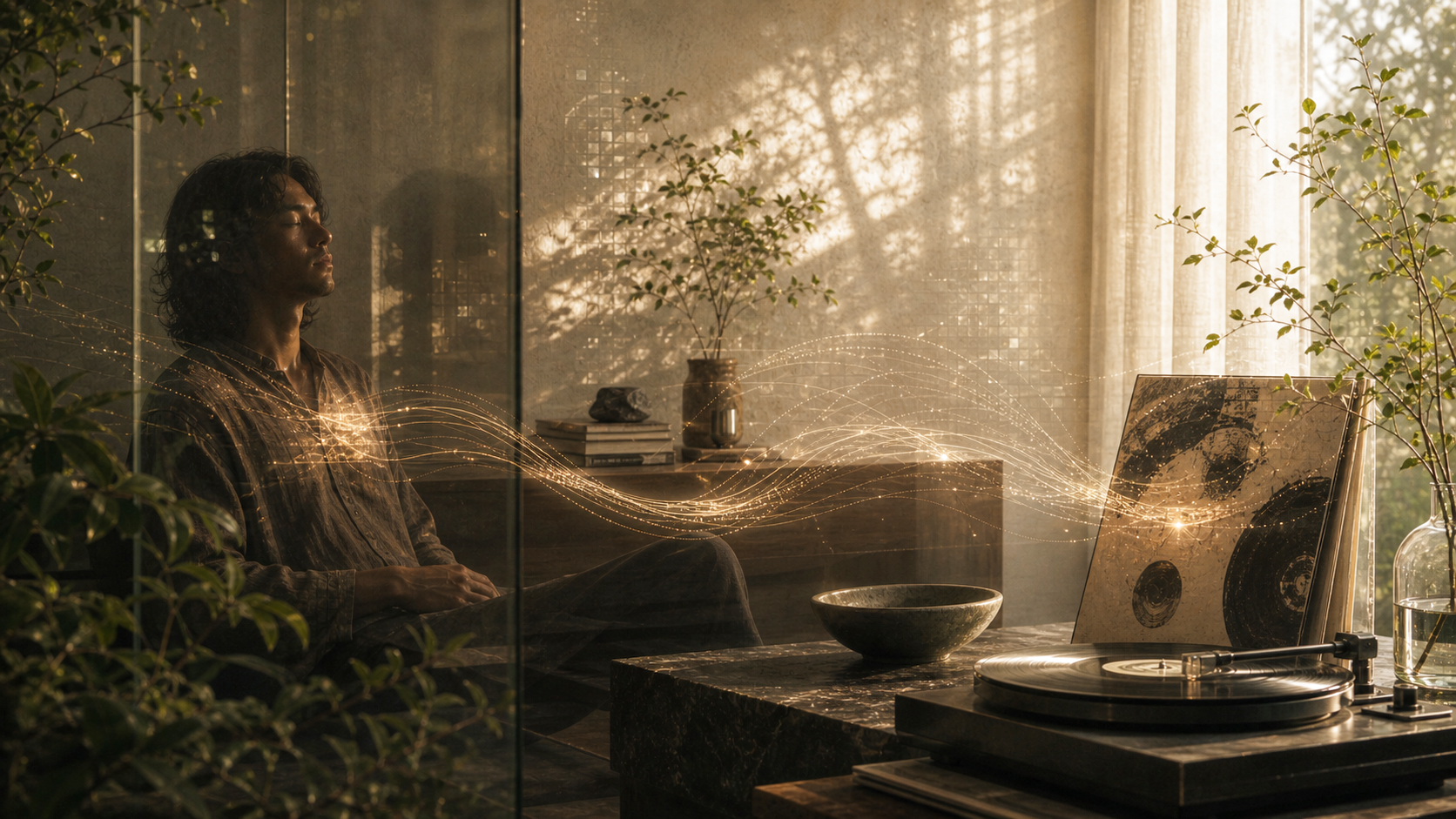
There is too much screen between us and our bodies. A song still gets through.
It happens before we can account for it. A track starts, and the room reorganizes. Shoulders drop or lift, a foot finds the floor, breath slows or quickens without being asked. Nobody explains it. Nobody has to. The body arrives first. Breath, pulse, memory, movement, charge, release, all of it lands before the part of us that names things has caught up.
This is older than taste. Before music becomes genre, before it becomes a playlist or a memory or a marker of who we are, it becomes a state in the body. Rhythm, voice, melody, silence, repetition, the low weight of bass, these are not decorations. They are tuning. Music is one of the oldest technologies the body has for changing the state it is in.
Music is not only something we consume. It is something that tunes us.
Which means it is not only taste. Not only an aesthetic to curate, not only background for getting things done, not only a credential of how evolved a person is supposed to be. Taste should not become a way to rank human worth. Those readings are real. They just arrive late. The body was already moving while the opinion was still loading.
Watch where it moves. A beat enters and the foot answers before the decision to move arrives, the sound reaching the muscles before the choice does. The body catches the pulse the way it catches a yawn. When a rhythm sits somewhere near a resting heart rate, the cardiovascular rhythm can drift toward it, and researchers describe the body falling into step. The science here is real and unsettled. We hold it loosely. Music can lengthen the breath, drawing it down toward a slow cadence the body already knows. Researchers have described the spontaneous sigh as a kind of respiratory reset, the system clearing its own throat. Bass is not heard so much as felt. Frequencies low enough to live in the chest set the sternum vibrating, and below sixty hertz the skin reads a soft flutter. Touch and hearing run on the same machinery. Bass arrives through both.
Then there is the voice, which carries state before it carries meaning. A falling, lower-pitched line is the sound of safe, what a caregiver reaches for over a crib without being taught. Warmer tones, slower contours, and the body on the other end settles, distress easing as a warmer, slower voice arrives, what looks like one nervous system helping settle another, before any word means anything. Many of us met regulation in a voice before we met language in it.
And the song attaches to the self that first heard it. Memory researchers describe a reminiscence bump, music from the identity-forming years tending to stick hardest, which may be why a track from sixteen can carry more weight than one from last spring. Identity gets built to a soundtrack. This is the song from the club, the one from the kitchen at 3 a.m., the one from the car with the windows down, the hymn from the church, the lullaby, the grief song, the prayer song. Nostalgia is not simple happiness. It is warmth braided with loss, the former self answering when the chords come back. The tension before a swell, the release when it breaks: the body bracing through what it predicts, then opening at what it could not. Goosebumps are an ancient reflex, the skin meeting the unexpected. The whole thing runs on prediction. Setup, delay, fulfillment, surprise. Music is a stream of forecasts the body cannot help but answer. All of it lands in the body before it lands anywhere else.
But something has crept into the way we use it. Streaming can flatten a song into a unit, one more item in an infinite feed. Algorithms can automate mood, choosing the feeling before we arrive at it. Wellness language can overclaim, selling frequency as a cure and certainty where mystery would be more honest. Frequency is measurable in some contexts. Sound is vibration, and the chest does respond to fifty hertz. But frequency is also a metaphor people reach for, and the metaphor floats away from the body the moment it promises to fix something. The body keeps the final vote. It does not care what the playlist is called. The useful question is what state a sound is training.
Repetition is its own doorway, and here the tension and the gift are the same thing. Sustained, predictable rhythm, drumming in a range many traditions seem to converge on, roughly four to seven beats a second, can loosen the grip of the thinking mind. Some recent work associates this with slower neural rhythms and absorbed states, though the link is still being mapped. Monotony quiets the part of the mind that narrates. It is a state, found and refound by people who never compared notes, which is why the question is not what to play, but what to let it do.
So we could listen differently. Not as consumption, but as stewardship. What returns a person to themselves? What opens attention without scattering it? What lets the thing under the noise finally be felt? And the question we skip: what silence does this sound require to mean anything at all? These are questions about which states we are rehearsing until they become normal.
This is not a protocol. No dosage, no prescribed cadence, no claim that the right track lowers a number or heals a person. If we use the word healing at all, we mean it as integration rather than escape, and integration does not always feel light. Sometimes the most honest sound is the one that finally lets the grief be felt. The point is fluency: knowing, in the body, what a sound is doing to us while it does it.
Before we had language for healing, we had rhythm.
The screen is still there. The song still gets through.