Interfaces / May 2026
What Plants Know That Machines Don't
AI can process language at impossible speed. A plant knows how to belong to a world.
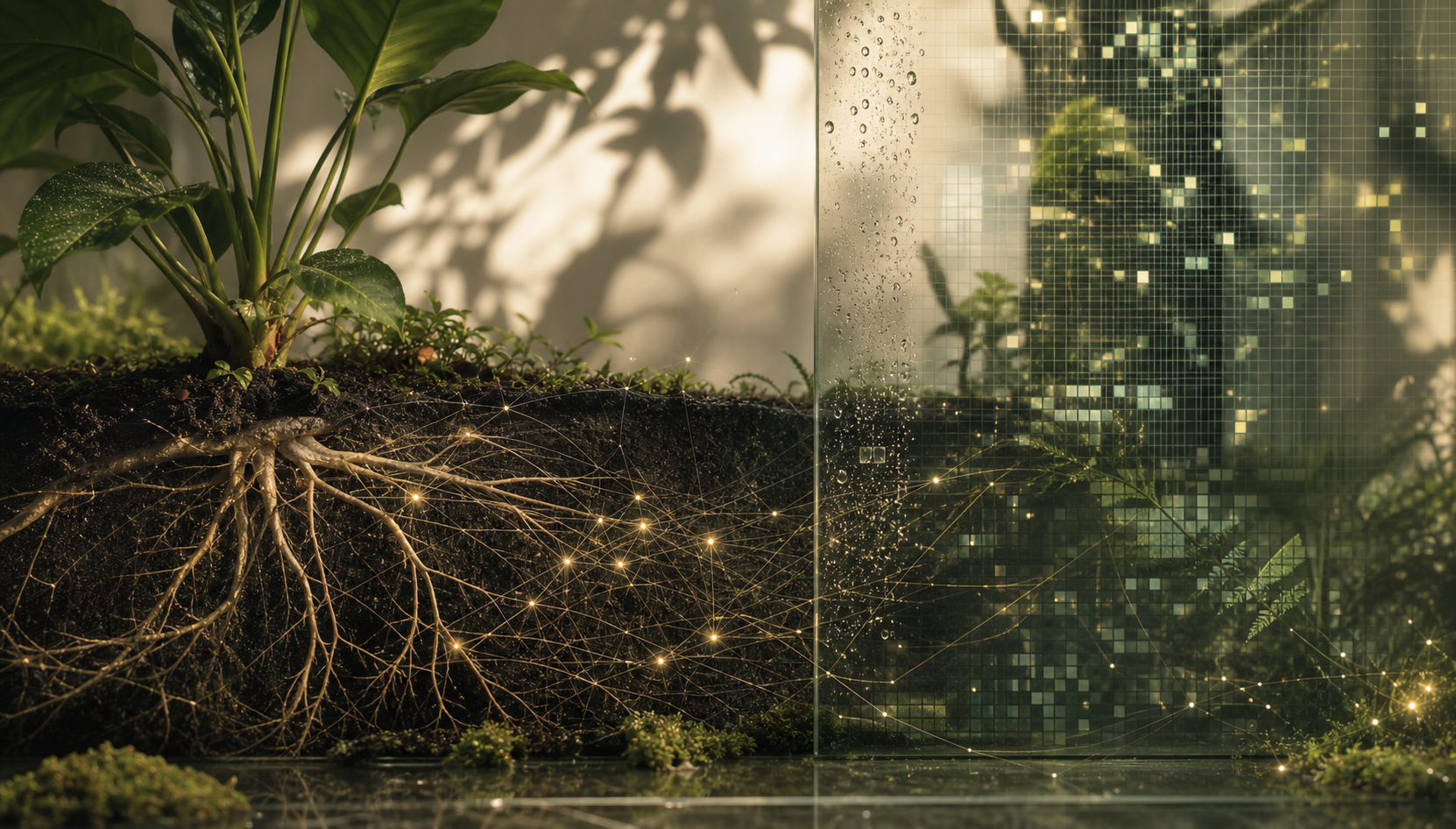
Artificial intelligence has made intelligence feel newly strange. We are watching machines write, summarize, plan, translate, generate images, reason through code, imitate style, and mirror language back to us with a fluency that would have sounded impossible not long ago.
At the same time, plants are making a quieter claim.
Not through spectacle. Through presence.
A plant is intelligence without performance. It senses light, gravity, moisture, chemistry, season, obstruction, damage, proximity. It communicates through roots, air, color, growth, and exchange. It belongs to a web of fungi, insects, microbes, weather, soil, and time. It does not need a screen to participate in information.
This does not mean plants are conscious in the human sense. It means the human definition of intelligence has been too narrow.
Machines are teaching us one kind of intelligence: symbolic, statistical, generative, fast, abstract, recombinant. Plants teach another: situated, relational, responsive, embodied, ecological, slow. One can simulate language. The other is inseparable from environment.
That difference matters.
AI can generate a description of sunlight. A plant turns toward it.
AI can explain interdependence. A plant lives it.
AI can model a garden. A plant negotiates with soil.
The point is not to romanticize plants or diminish machines. The point is to let each reveal the limits of the other. When we spend too much time with digital intelligence, we can begin to confuse intelligence with output. Plants remind us that intelligence can also be orientation, adaptation, patience, and relationship.
This is why plants belong in the conversation about technology and consciousness. They are not an aesthetic counterweight to screens. They are a different ontology. They show us a way of being where perception is distributed, growth is responsive, and the self is not sealed off from the field.
Modern people need this reminder because so much of digital life trains separation. User from environment. Mind from body. Content from context. Productivity from season. Identity from place. Plants quietly dissolve those boundaries. Their life is a continuous negotiation with conditions.
What would technology look like if it learned from that?
Maybe it would become less extractive and more attuned. Less addictive and more seasonal. Less obsessed with frictionlessness and more respectful of rhythm. Less focused on replacing human capacity and more focused on restoring it. Less like a feed and more like a garden.
The future of AI will not only be a question of what machines can do. It will be a question of what kinds of humans those machines encourage us to become.
Plants cannot answer that for us. But they can help us remember the intelligence of being alive.